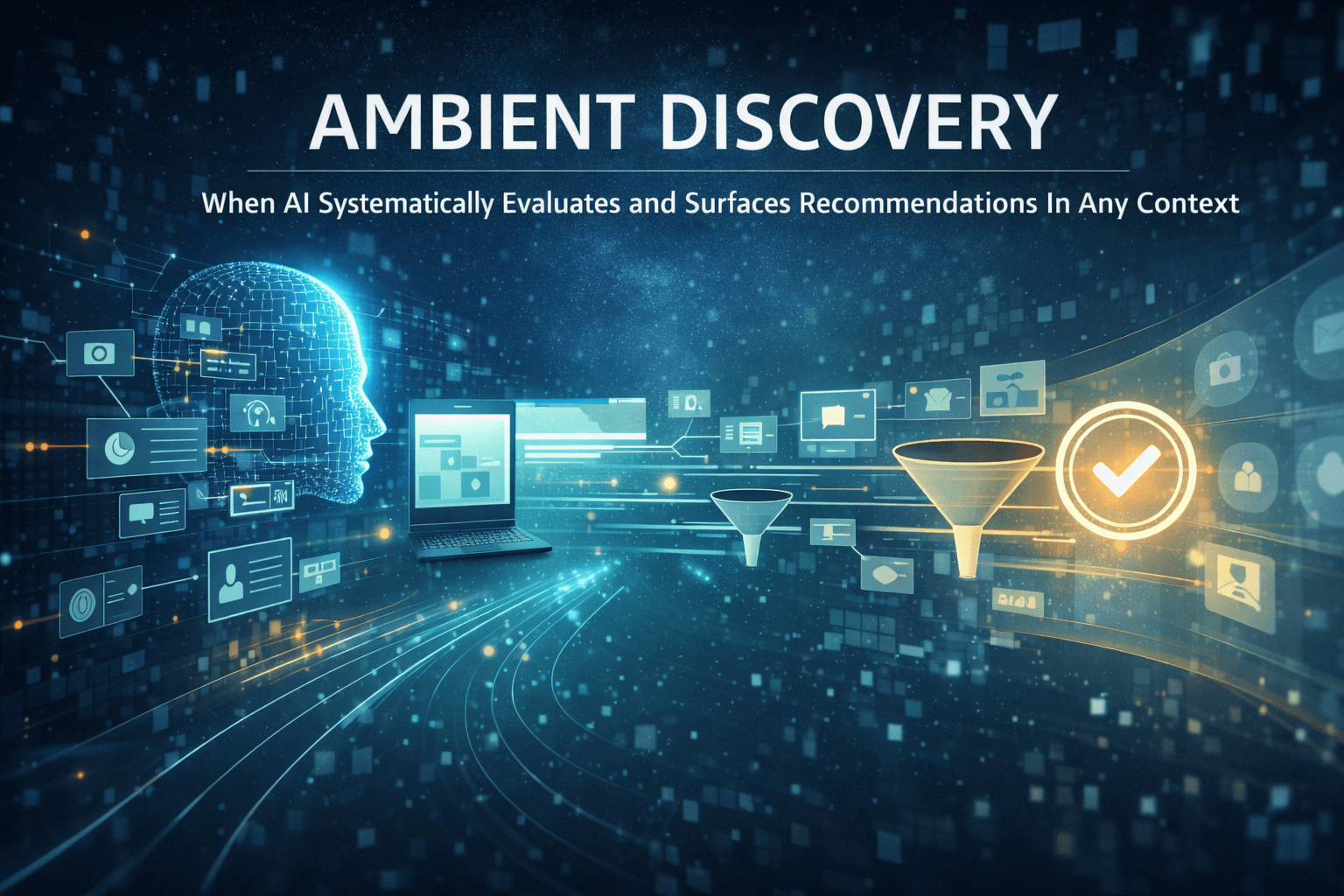
Search has historically been treated as a discrete task. Users opened a search engine, expressed intent, reviewed results, and returned to their work, creating clear boundaries around when discovery occurred. Those boundaries are dissolving. As AI becomes embedded across devices, applications, and operating systems, discovery no longer requires deliberate initiation. Instead, it happens continuously in the background while people go about their day.
What was once a separate action becomes an always-present capability.
Definition
Ambient discovery describes an environment in which systems surface recommendations proactively based on context rather than explicit queries. Instead of waiting for users to ask, the system continuously evaluates what might be useful and introduces suggestions accordingly.
Discovery therefore shifts from episodic search sessions to continuous presence within everyday digital environments.
How It Works
Ambient systems rely on familiar mechanisms such as retrieval, entity recognition, authority assessment, corroborated knowledge, and confidence scoring. The core logic remains similar to search.
The difference is frequency. These evaluations run constantly rather than occasionally, assessing brands across changing contexts throughout the day. Systems determine what to surface based on relevance and trust at any given moment, not just during a search session.
As a result, brands are continuously evaluated rather than periodically considered.
Evidence in Practice
Ambient discovery is already visible across modern technology.
Productivity software suggests tools or services while drafting emails or documents. Operating systems recommend apps based on current tasks. Vehicles surface nearby destinations or services during navigation. Wearables provide health or lifestyle suggestions without any explicit request. Assistants proactively introduce vendors or products while planning daily activities.
In each case, discovery occurs inside another workflow rather than within a dedicated search interface.
Why Visibility Changes
Because ambient systems surface only a small number of trusted suggestions, most alternatives are filtered out before they ever reach the user. Exposure becomes selective rather than competitive, and the system assumes the role of primary gatekeeper.
Instead of competing for attention at a specific moment, brands must consistently meet the system’s standards for credibility and safety. Visibility becomes a function of persistent trust rather than timely interception.
Implications
When discovery becomes continuous rather than episodic, short-term optimisation naturally loses effectiveness. Campaign spikes and momentary tactics matter less because there is no single opportunity to capture attention. Systems are constantly reassessing credibility.
What matters instead is durable trust. Brands that maintain consistent identity, stable authority signals, reliable information, and low ambiguity are easier for systems to surface confidently. Over time, credibility compounds while inconsistency is gradually excluded.
The strategic question therefore shifts from “How do we win this search?” to “Would our brand naturally surface at any moment because the system already trusts it?”
This shift requires not just a change in tactics, but a change in how brands think about qualification for visibility.
What This Requires
In an environment shaped by ambient discovery, brands must shift investment away from short-term optimisation cycles and toward systems that reinforce long-term trust. This requires maintaining a consistent entity identity across platforms, reducing ambiguity in how the brand is represented, and ensuring that authoritative, corroborated information remains stable over time. The objective is not to be discovered at the right moment, but to remain continuously eligible for recommendation whenever context makes the brand relevant.
Conclusion
Ambient discovery expands visibility beyond search and into the fabric of everyday digital life, where recommendations are embedded directly into the tools and workflows people already use. As systems become more proactive, exposure depends less on competing for attention during isolated moments and more on whether a brand consistently qualifies as trustworthy across contexts. Discovery becomes continuous and environmental, operating quietly in the background. In such an environment, only brands that maintain sustained credibility and authority remain visible.
About the Authors
Ruan Masuret and Juanita Martinaglia are the co-founders of Netsleek, where they research and develop frameworks around AI-driven discovery, brand eligibility for recommendation, and the evolving mechanics of search and selection. Their work explores how AI systems evaluate, filter, and surface brands across ambient and zero-query discovery environments.